
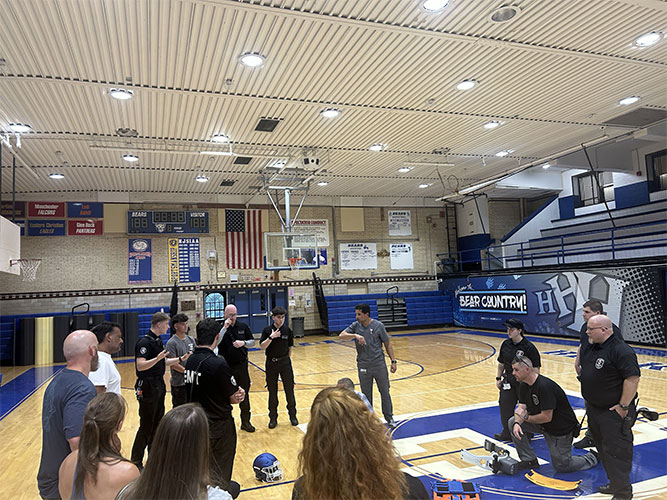
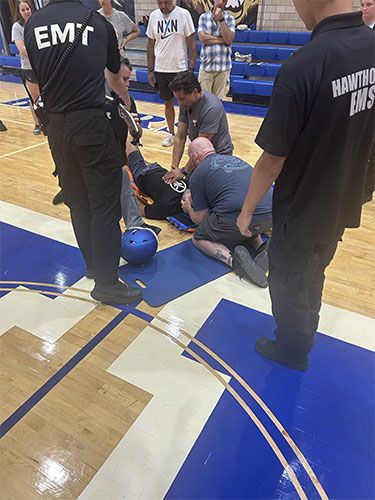
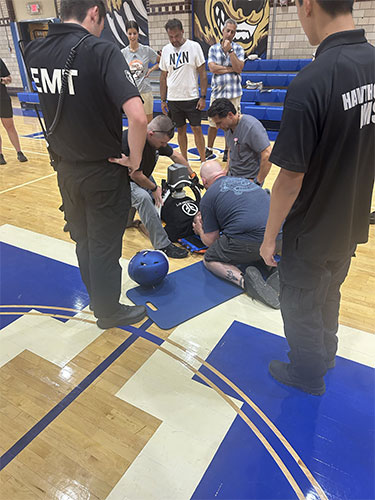
One of the most effective strategies against catastrophic injuries in athletics is having a comprehensive, detailed, and rehearsed plan for medical emergencies. This is known as an Emergency Action Plan (EAP).
The National Athletic Trainers’ Association (NATA) has published the position statement “Emergency Planning in Athletics”, which outlines best practices for developing and implementing an EAP. The principles in that document set the standard for how we should prepare for and respond to life-threatening events in sport.
An EAP is essential for every school, university, and each athletic venue where athletes practice, train, or compete. The purpose of the EAP is simple but critical: to ensure that the response to an emergency is rapid, organized, and effective. When emergencies occur, hesitation or confusion can cost valuable seconds. A well-designed plan gives staff confidence and control in those moments.
It’s also important to recognize that an EAP is not just best practice, it’s part of our professional and legal responsibility. Institutions that fail to establish and follow an EAP may be considered negligent in the event of catastrophic injury. Having a plan in place is not optional.
While an EAP must be thorough, it should also be flexible enough to adapt to a variety of emergencies. Typically, the healthcare team, which includes, athletic trainers and team physicians, leads the development of the plan. Collaboration is key. EMS should be directly involved in the development of the EAP, and the plan should ultimately be reviewed and approved by the school or university’s medical director. This not only ensures accuracy but also strengthens communication between on-site personnel and community emergency responders. An EAP is the foundation of athlete safety and a shared responsibility across the entire athletic community.
- Courson RW, Goldenberg M, Adams KG, et al. Inter-Association Consensus Statement on Best Practices for Sports Medicine Management for Secondary Schools and Colleges. J Athl Train. 2014;49(1):128-137.
- Andersen J, Courson RW, Kleiner DM, McLoda TA. National Athletic Trainers’ Association position statement: emergency planning in athletics. J Athl Train. 2002;37(1):99–104.
EAP needs to be site specific and address multiple components including:
- Emergency Personnel:
- Identify all members of emergency team
- Define roles and responsibilities of each person during medical emergency
- Communication:
- provide detailed instructions and venue-specific direction for EMS responders
- make sure everyone has phone numbers if ATC not on site.
- Emergency Equipment:
- Ensure all critical equipment such as AED, spine boards, first aid kits is quickly accessible and maintained on regular basis
- Venue Directions & Maps:
- provide clear, venue specific maps for EMS and emergency personnel
- include step by step instructions to have safe efficient access to the site
- Roles of First Responders:
- Establish procedures for
- EMS activation (universal signal)
- Equipment removal
- Scene safety
- Guiding EMS to the scene
- Establish procedures for


