
Understanding Cervical Joint Position Error (JPE) Testing: What It Tells Us About Neck Proprioception
Have you ever noticed how your body instinctively knows where your head is, even when your eyes are closed? That sense of awareness, called proprioception, is a critical part of how we move, balance, and react to our surroundings. When someone experiences a concussion, whiplash injury, or chronic neck pain, this sense can become disrupted.
That’s where Cervical Joint Position Error (JPE) testing comes in.
What Is JPE Testing?
Cervical JPE testing is a simple, non-invasive way to assess how accurately your neck muscles and joints can reposition your head after movement. In other words, it measures your body’s ability to “know” where your head is in space without relying on vision.
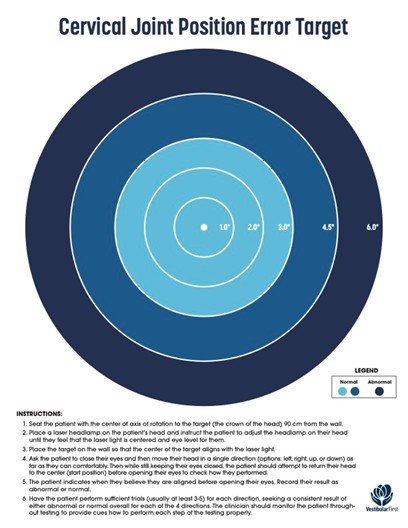
During the test, a small laser pointer is attached to the patient’s head and aimed at a target on the wall. With their eyes open, the patient centers the laser on the target. Then, keeping their eyes closed, they rotate their head to one side and try to return to the starting position. The clinician notes how far off the laser lands from the center (this deviation is called the joint position error.)
How the Test Works
Here’s how a typical JPE test is performed:
- The patient sits upright, about 90 cm from a target on the wall.
- A laser headlamp or headband-mounted laser is aligned with the target’s center.
- The patient closes their eyes, moves their head (left, right, up, or down), and then attempts to return to the original position.
- The clinician records the error distance between the return point and the true center.
- The process is repeated several times in each direction for accuracy.
If the head consistently returns off-center by more than a few degrees (typically greater than 4.5°), it may suggest cervical sensorimotor dysfunction, a common finding after concussion or neck trauma.
Why It Matters
The cervical spine is rich in sensory receptors that provide constant feedback to the brain about head position and movement. When this system is disrupted, patients may experience:
- Dizziness or unsteadiness
- Difficulty focusing or tracking objects
- Headaches or neck pain
- Delayed reaction times or impaired athletic performance
By identifying these deficits early, clinicians can create targeted rehabilitation programs that retrain proprioception, improve postural control, and reduce symptoms.
A Simple but Powerful Assessment Tool
“This test is a great way to understand head and neck proprioception-your body’s ability to know where your head is in space.”
It’s quick, safe, and can be performed in nearly any clinical or athletic setting. For physical therapists, athletic trainers, and sports medicine providers, JPE testing offers valuable insight into the overlooked sensorimotor aspects of concussion and neck injury recovery.
Summary
Cervical Joint Position Error testing helps bridge the gap between symptom description and measurable function. By understanding how the head and neck communicate with the brain, clinicians can deliver more precise care and accelerate safe return to play or daily activity.
References:
AlDahas, F.A, Aljawad, M. M., & Al-Dhafer, N. 2024. Responsiveness of the cervical joint position error test to detect changes in neck proprioception following four weeks of home-based proprioceptive training. PLOS ONE, 19(3), e0303066.
Cheever KM, et al. Cervical injury assessments for concussion evaluation. 2016. Overview of cervical proprioceptive testing, including JPE, in concussion evaluation. Describes physiological rationale and clinical applications.
Treleaven, J., Jull, G., & LowChoy, N. (2006). The relationship of cervical joint position error to balance and eye movement disturbances in persistent whiplash-associated disorders. Manual Therapy, 11 (2), 99-106
Treleaven, J., Jull, G., & Sterling, M. (2003) Dizziness and unsteadiness following whiplash injury: characteristic features and relationship with cervical joint position error. Journal of Rehabilitation Medicine,35 (1), 36-43.
JPE Target – Vestibular First


