
Diagnosing a concussion is not always straightforward. Symptoms can be subtle, delayed, or overlap with other injuries, making objective, structured testing essential. A zero-cost validated tool in sports medicine is the Vestibular/Ocular Motor Screen (VOMS).
The VOMS provides a fast, reliable way to evaluate athletes both on the sideline and in the clinic. This screening was developed to identify dysfunction in the vestibular and oculomotor systems. These two areas commonly disrupted after concussion. While it doesn’t replace a full neurological exam, it is one of the most sensitive tools we have for detecting concussion related impairments.
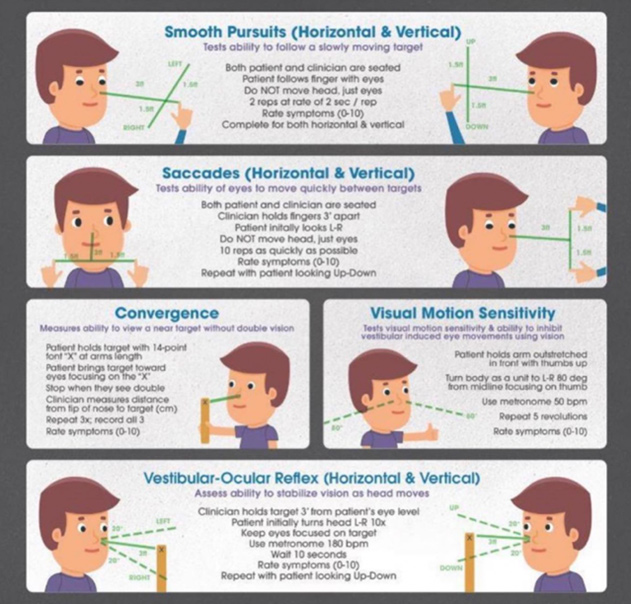
Standard VOMS Test Order
- Baseline Symptoms
- Rating of headache, dizziness, nausea, fogginess (0–10)
- Smooth Pursuits
- Horizontal Saccades
- Vertical Saccades
- Convergence
- Near point of convergence (NPC) distance
- 3 trials
- Horizontal Vestibular-Ocular Reflex (VOR)
- Head rotation at ~180 bpm
- Vertical Vestibular-Ocular Reflex (VOR)
- Visual Motion Sensitivity (VMS)
- Full-body rotation + fixed gaze (80 bpm)
- Saccadic Eye Movements
Saccades test the brain’s ability to rapidly shift focus between two points.
How it's performed:
With hands about 3 feet away from your patient (about arm’s length), ask the subject to alternately fixate on your fingertips positioned about 18 inches apart. Ask them to move their eyes quickly back and forth (horizontal saccades) and then up and down (vertical saccades) for 10-20 repetitions in each plane while keeping the head still.Why it matters:
Abnormal movements or symptom-provoking saccades indicate oculomotor dysfunction, a common concussion finding. Symptoms consistent with saccadic dysfunction include headaches, fogginess, and difficulty reading or focusing. - Vestibular-Ocular Reflex (VOR)
The VOR assesses how well the eyes stay fixed on a target while the head is in motion.
How it's performed:
The patient focuses on a midline target held at about 3 feet (arm’s length) from the patient, and then asking the patient to turn their head side-to-side (horizontal VOR) and up-and-down (vertical VOR) for 10-20 repetitions at a pace of 3 cycles per second in each plane.Why it matters:
A disrupted VOR often leads to dizziness, imbalance, and blurred vision. Persistence of these symptoms strongly correlate with prolonged recovery. - Visual Motion Sensitivity (VMS)
This evaluates sensitivity to busy environments or motion in the visual field.
How it's performed:
The patient fixates on a target (their own thumb or a pen held in their hand) while rotating their torso and head together about 160 degrees right and left at a rhythm of 50-60 bpm (one full cycle per second).Why it matters:
Athletes with difficulty in this domain often struggle in hallways, restaurants, stores, or classrooms. It is a sensitive marker of concussion diagnosis. - Convergence
Convergence measures how well the eyes come together to focus on a near target.
How it's performed:
A small target (such as the tip of a pen or “X” drawn on a card) is slowly brought toward the nose while the patient maintains focus. The examiner notes the distance where the object becomes double or there is an inability to converge further. In some instances, there may be a movement of one eye away from center during this challenge (exotropia).Normal:
A near point of convergence < 5 cm is normal.Why it matters:
Convergence > 5cm is a reliable indicator of concussion. Vergence abnormalities contribute to headaches, difficulty reading, and trouble with screens, which can be major barriers to academics and sport participation.
Why the VOMS is So Effective
While objective findings (such as measurement distances or eye movement deviations) are helpful, the most widely used component of the VOMS is symptoms provocation during testing. Objective changes become more apparent to the experienced clinician and will be covered in another bulletin. There are several publications that rely solely on symptoms provocation as an indicator of concussion diagnosis
If your athlete reports increase in headache, dizziness, nausea, or fogginess during any component, this supports a concussion diagnosis and can help guide which systems need targeted rehabilitation.
Multiple studies have shown the VOMS to have high sensitivity for concussion, making it a great complement to tools like SCAT6, neurologic exam, computerized testing, and clinical judgment.
Key Points
- The VOMS is a fast, evidence-based screening tool used both on the field and in clinic.
- It assesses oculomotor and vestibular systems, areas frequently impaired after concussion.
- Symptom provocation during testing is one of the strongest indicators of concussion.
- Identifying specific deficits early allows for targeted vision and vestibular rehabilitation, which speeds recovery and improves return-to-play outcomes.
References:
Mucha, A. D., Collins, M. W., Elbin, R. J., Furman, J. M., Troutman-Enseki, C., DeWolf, R. M., Marchetti, G., & Kontos, A. P. (2014). A Brief Vestibular/Ocular Motor Screening (VOMS) Assessment to Evaluate Concussions: Preliminary Findings. American Journal of Sports Medicine, 42(10), 2479–2486. DOI: 10.1177/0363546514543775.
Kontos, A. P., Monti, K., Eagle, S. R., Thomasma, E., Holland, C. L., Thomas, D., Bitzer, H. B., Mucha, A., & Collins, M. W. (2021). Test-retest reliability of the Vestibular Ocular Motor Screening (VOMS) tool and modified Balance Error Scoring System (mBESS) in US military personnel. Journal of Science and Medicine in Sport, 24(3), 264–268. DOI: 10.1016/j.jsams.2020.08.012.
Corwin, D. J., Wiebe, D. J., Zonfrillo, M. R., Grady, M. F., Robinson, R. L., & Makoroff, K. L. (2021). Evaluation of the Vestibular and Ocular Motor Screening (VOMS) as a Prognostic Tool for Protracted Recovery Following Pediatric Sports-Related Concussion. BMJ Open Sport & Exercise Medicine
Harris, L., Antonaros, K., Cole, H., Daniels, P., Gould, K., Ivey, T., Lewis, A., Maxwell, A., Miles, P. (2023). The Value of the Vestibular/Ocular Motor Screening (VOMS) in Evaluating Adolescent Patients with Concussions. Journal of Sports Medicine and Allied Health Sciences, 9(1), Article 5. DOI: 10.25035/jsmahs.09.01.05.
Büttner, F., Howell, D. R., Doherty, C., Blake, C., Ryan, J., & Delahunt, E. (2021). Clinical detection and recovery of vestibular and oculomotor impairments among amateur athletes following sport-related concussion: A prospective, matched-cohort study. Journal of Head Trauma Rehabilitation, 36(2), 87-95.


