
It can sometimes be difficult to tell the difference between a mild concussion and a more serious, life-threatening brain injury.
Call 911 immediately or go to the nearest emergency department if you notice any of the following danger signs after a bump, blow, or jolt to the head:
- Convulsions or seizures (shaking or twitching)
- Inability to recognize people or places
- Repeated nausea or vomiting
- Unusual behavior, increasing confusion, restlessness, or agitation
- Loss of consciousness with increasing drowsiness or difficulty staying awake
- Slurred speech, weakness, numbness, or decreased coordination
- A headache that worsens and does not go away
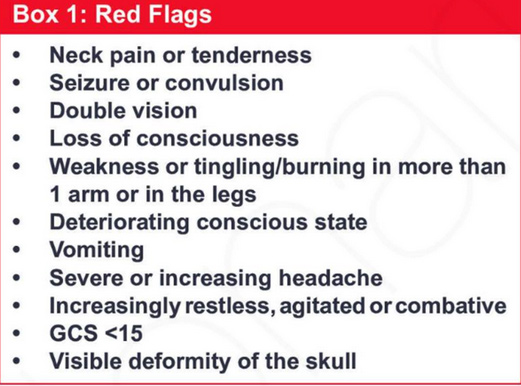
Image CourtesySCAT6 {Echemendia RJ, et al. Br J Sports Med June 2023 Vol 57 No 11}
What is a Head CT Scan?
A head CT scan (Computerized Tomography or CAT scan) is an imaging study that uses X-rays and computer technology to create cross-sectional images of the brain and skull. Sometimes, a contrast dye may be used to highlight certain structures more clearly.
This test helps doctors quickly identify injuries or abnormalities in the brain and surrounding tissues.
Indications for a Head CT Scan
Your doctor may order a head CT scan to:
- Diagnose skull fractures, brain bleeding, stroke, infections, or other life-threatening brain injuries.
- Evaluate the cause of concerning symptoms such as:
- Severe or persistent headache
- Confusion or altered mental state
- Muscle weakness
- Seizures
- Vision or hearing loss
- Speech difficulties
Preparing for a Head CT Scan
- A radiology technician will review your medical history before the test. Be sure to tell your doctor about any medications you are taking, as well as those you may need to stop before the scan. If contrast dye is required, your care team will discuss allergies and kidney function to ensure safety.
Other Sports Concussion Topics


